


Last Updated: September 14, 2026
One of the most practical ways to get your vehicle back on the road without paying new-part prices is to buy a used car part from a wrecker. It works best if you follow three simple steps: identify the exact part you need, confirm its condition and compatibility, and check the details before arranging your purchase. Get these right and you’ll save time, avoid ordering the wrong part, and know what you’re actually paying for. If you’ve never worked with a car wrecker before, the process is easier than most people expect. Here is the way it works. 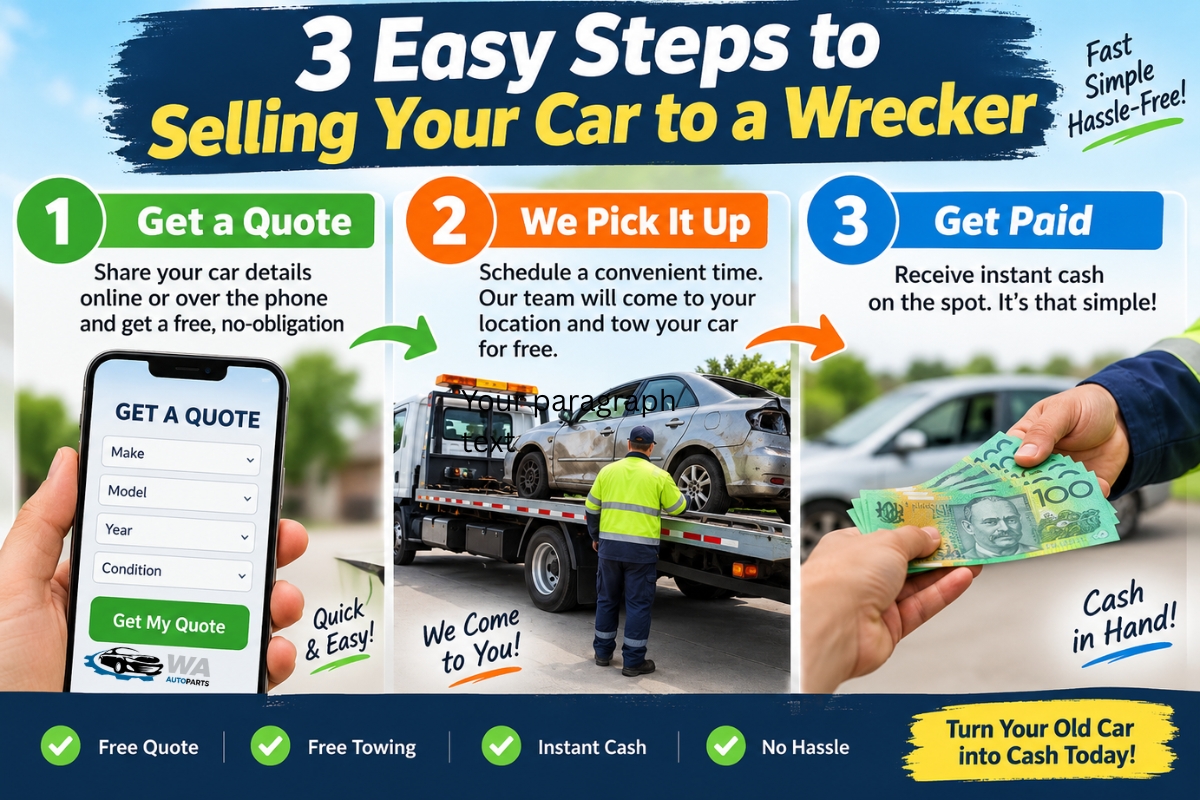
Step 1 – Identify the Exact Car Part You Need
The more information you can give them on your vehicle, the faster a wrecker can tell you if they have a matching part. Have these details on hand at a minimum:
- Make and Model
- Manufacture year
- Engine code or engine type
- Transmission type (auto or manual, if applicable)
- Part name you require; part number if you have access to it VIN if applicable
This is important because manufacturers change specifications within the same model line, sometimes more than once. For example, a 2015 Ford Focus might have been sold with different engine options depending on the build date and market. Two cars with the same badge on the back can take completely different alternators, headlights or engine parts. If you mention the year and the engine up front, that eliminates a lot of guessing, and a part number (if you can find one, usually stamped or labeled on the original part) narrows it down even more.
Step 2 – Check the Part’s Condition and Compatibility
Once a wrecker has found a potential match, it is worth asking a few direct questions before agreeing to buy:
- Is this part confirmed to fit my specific make, model, year, and engine variant?
- Are the part numbers the same or a known compatible equivalent?
- Was the part inspected? What did that involve?
- Any signs of wear, damage or corrosion?
- Can a home mechanic fit this part or does it need to be installed professionally?
Used parts come in all different conditions, and that’s to be expected. They’ve come off of real vehicles that have been driven, not off a factory line. A used alternator might be in perfect working order but cosmetically worn. A second-hand bumper could be structurally sound but needs a repaint. None of this means that a part isn’t suitable, but you should know what you’re getting before you commit. If the wrecker can’t answer basic questions about the condition or compatibility of a part, that’s a pretty good reason to ask more questions before you buy.
Step 3 – Confirm the Details and Arrange Your Purchase
Before finalizing anything, make sure:
- The part supplied
- Check fitment with your vehicle
- The part’s condition
- The cost
- Whether the part is on stock or has to be sourced
- Collection or delivery arrangements
This is also where having a wrecker already helps. WA Auto Parts, on Sheffield Road, Welshpool, stocks used and recycled car parts for a vast range of makes and models and can discuss vehicle details with you to determine the suitability of parts available. As with any tow truck, it’s wise to double-check compatibility and condition for your particular vehicle before finalizing the purchase.
What Car Parts Can You Buy from a Wrecker?
Availability depends on what cars have recently passed through a wrecker’s yard so no wrecker will have everything for every car at all times. That said, commonly available recycled parts include:
- Engines and engine components
- Transmissions
- Alternators and starter motors
- Headlights and taillights
- Mirrors
- Doors and bonnets
- Bumpers and body panels
- Interior components such as seats and trim
- Suspension components
- Wheels
- Electrical components such as wiring looms and sensors
If you want something a little more unusual, ask rather than assume you can’t get it, as wrecking yards turnover stock regularly.
Why Choose Used or Recycled Car Parts?
Used parts aren’t automatically the right choice for every job, but there are situations where they make clear sense:
- They’re often less expensive than buying new, particularly for older vehicles where new parts can be hard to source
- They can be the only realistic option for discontinued components no longer manufactured
- They allow serviceable parts from an otherwise written-off vehicle to be reused rather than scrapped
- They reduce unnecessary waste by keeping usable components in circulation
Used parts won’t always be cheaper than new ones and won’t always be the better choice — for safety-critical components, some owners prefer new parts with a manufacturer warranty. It really depends on the part, the age of the vehicle and what you’re trying to do.
What Information Should You Give a Car Wrecker?
Having this ready before you call or enquire will speed things up considerably:
- Vehicle make
- Model
- Year
- Engine type
- Transmission type
- VIN, where appropriate
- Registration details, where relevant
- The specific part required
- Part number, if available
Frequently Asked Questions
How do you buy used car parts from a wrecker?
You tell us your car make, model, year, and engine details and confirm if the wrecker has a matching part in stock. Once compatibility and condition are established, agree on price and arrange collection or delivery. A part number in hand greatly speeds up the process.
What does a Wrecker Need To Know?
Wreckers will usually ask you to provide the make, model, year, engine type and transmission type of the vehicle, as well as the part you want. A VIN or part number helps narrow down the right match because the same model can have several variants during a production run, if you can get it.
How do you verify if a used car part is compatible?
Usually, compatibility is verified by cross-referencing your vehicle’s make, model, year, and engine variant to the specifications of the part, preferably backed up by a part number match. It’s worth asking the wrecker themselves to confirm this rather than assuming a part will fit based on model name alone.
Are used car parts worth it?
Reliability will depend on the history and condition of the individual part, which will vary because used parts come from real vehicles, not an assembly line. Ask about the condition of a part and if it was inspected before purchase, so you know what to expect.
What car parts can you get from a wrecker?
You can get engines, transmissions, alternators, starter motors, lights, mirrors, doors, bumpers, interior parts, suspension parts and wheels. Availability depends on current stock so it’s best to call and ask about the particular part and vehicle you need.